
Author: Dan Lear
People are talking about us behind our back, lawyers. And they’re not complimenting our excellent credentials or impeccably adorned offices. Instead, there’s been a lot of press over the last few weeks about “dumb lawyers,” or, if you prefer, the “dumbing of lawyers.”
First was Bloomberg Businessweek‘s front-page story in late August: “Are Lawyers Getting Dumber?” Or, as it was written on the cover, “Dumber Are Getting Lawyers?”
Then, late last month Law School Transparency, or LST—full disclosure, I am a member of LST’s national advisory council—released a report that has been quoted everywhere fromThe Wall Street Journal to the The New York Times with headlines like “Here Comes a National Plague of Dumb Lawyers.”
What’s going on?
In its piece, Bloomberg Businessweek noted a year-over-year increase in the number of candidates who fail the bar exam. After “norming” lower test scores across years of records, the National Conference of Bar Examiners, or the NCBE, the entity that administers the test, concluded that the exam had not gotten harder; rather, those sitting for the exam today are less qualified (read: dumber) than previous groups of examinees. Not surprisingly, law school deans rejected that explanation, and 79 of them wrote a letter demanding an investigation into the integrity and fairness of the July 2014 exam. The debate rages on, even as results from the summer 2015 exam indicate that scores have continued to fall.
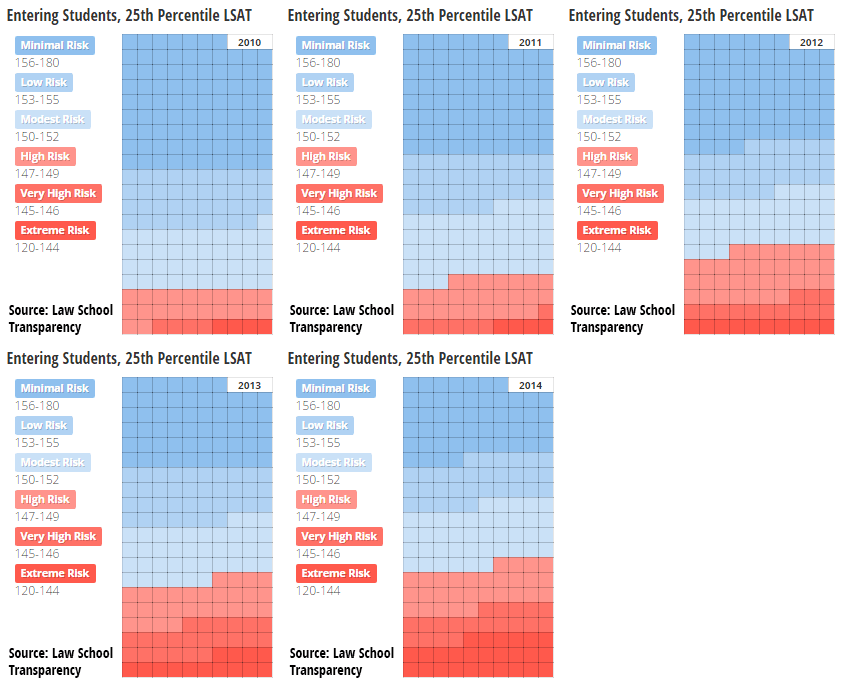
The LST report released late last month seems to bolster the NCBE’s claims. Specifically, the report suggests that “many law schools are enrolling students who face substantial risk of failing the bar exam [in order to] keep their doors open.” The report doesn’t skimp on facts or data, either. Based on years of historical data that demonstrates a strong correlation between LSAT scores and bar exam scores, the LST report shows that more law schools are enrolling more students who are at risk of failing the bar exam.
Quoting from the LST report:
- “In 2010, 30 schools admitted classes consisting of at least 25% at-risk students. Of those 30 schools there were 4 extreme risk, 4 very high risk, and 22 high risk schools.
- In 2014, 74 schools admitted classes consisting of at least 25% at-risk students. Of those 74 schools there were 26 extreme risk, 19 very high risk, and 29 high risk.
- In 2014, 37 schools admitted classes consisting of at least 50% at-risk students (7 extreme, 11 very high, 19 high), up from 9 (3 very high, 6 high).”
This graphic from the LST report shows the evolution clearly:


Why should you care?
As far as the public is concerned, the legal profession is only as good as its weakest member. Incompetent lawyering is bad for all of us. Although the recent revelations suggest a decline in the quality of law students and those sitting for the bar exam—not necessarily in the quality of practicing lawyers—a decline in quality among those aspiring to be lawyers is likely to lead to less competent lawyers in the long run. And greater lawyer incompetence leads to more malpractice claims, which ultimately lead to higher malpractice insurance rates. Greater lawyer incompetence also further erodes public confidence in the professionby creating bad experiences for individual clients and, if the malpractice is bad enough or occurs in a publicly scrutinized case, by undermining the legal industry from a public relations standpoint.
Second, the profession is already facing tremendous headwind in the form of slow internal technological adoption, a mass of unemployed young lawyers with flagging if not non-existent job prospects, aggressive competition from non-lawyer resources, and a quickly and radically changing work landscape characterized by savvy consumers who want “more for less.” The last thing the legal profession needs is a weakened stock of incoming lawyers, much less controversy around a new generation of legal professionals.
So what can you do?
The first step is to simply become aware of these trends and forces. Transparency is the hallmark of the 21st century. Whereas the bar exam information from the NCBE or the LST report may have previously been known to only a select few, it’s now public knowledge available on the Internet for all to see. From this, lawyers can learn powerful lessons not only about how transparency affects large institutions in the digital age, but also about how transparency affects the legal profession.
The second thing to do is get involved. Lobby the ABA, your local bar, regulatory authorities, and your alma mater to stop deceptive practices. Many institutions have perpetuated this increasingly problematic legal education landscape. It’s not just law schools. ABA members and others can lobby the ABA Section on Legal Education, the group that sanctions and regulates law schools, on legal education for change. Don’t forget that while the ABA sanctions law schools, the right to practice law is granted locally. You can lobby your local regulatory authority or work with a local mandatory or voluntary bar to enact rules and policies that, as the LST transparency report urges, “educate prospective members of the legal profession in a manner consistent with rest of the profession’s obligations to society.” Finally, you can lobby your alma mater for change. I don’t know about you, but I receive regular fundraising solicitations from my law school. While many of us are probably not in a position to give much to these campaigns, law schools might be more responsive to calls for change if they knew fundraising dollars would be withheld unless they took a more responsible path with regard to admissions.
It used to be that lawyers would jockey against each other to improve the value of their degree and institution. Ever competitive, these type-A professionals felt that an increase in the rank of their alma mater on U.S. News & World Report lists increased the value of their degree or improved their own sense of self-worth. Falling bar pass rates and greater transparency about legal education have changed that. This new landscape is calling for lawyers to band together to raise the esteem of the the juris doctorate degree and of the profession or risk cultural devaluation before the drumbeat of “dumb lawyers” drowns out the good work that so many lawyers do and have done.