By Fadi Agour, J.D. · Updated November 19, 2026 · Facts last reviewed November 19, 2026
Key takeaways
- AI is now a first stop for legal questions. Clio's 2026 Legal Trends Report found 24% of U.S. adults have already used AI to answer a legal question and another 40% would consider it; 46% would consult AI before contacting a lawyer.
- AI answers reduce clicks. When a Google AI summary appeared, users clicked a traditional result in 8% of visits versus 15% without one, according to Pew Research Center.
- Reviews set the shortlist. BrightLocal's 2026 survey found 74% of consumers look for reviews from the last three months, 47% won't use a business with fewer than 20 reviews, and 45% now use ChatGPT or other AI tools for local recommendations, up from 6%.
- Clients still choose on experience and reputation, with client reviews, free consultations and clear information close behind (Clio, 2025 Legal Trends Report).
- Speed still decides who gets the call. Only 40% of firms picked up the phone in Clio's secret-shopper study, and companies that contact a lead within an hour are nearly seven times as likely to qualify it (Harvard Business Review).
Why the consultation starts before the first call
Most firms still think of intake as the moment the phone rings. For the client, that moment comes near the end of a decision process that started days or hours earlier. Someone hurt in a crash, denied disability benefits or served with papers now does three things before they talk to a lawyer: they try to understand their problem (increasingly with AI), they look up who can help (on Google, in maps, in AI answers and on review sites), and they decide who seems worth calling.
This matters even when the firm did not pay for that research step. When a firm buys an exclusive lead, the person who filled out the form will still search the firm's name, read its reviews and compare it with whoever else they contacted. A strong lead can be lost to a weak profile, a slow callback or an award badge nobody can explain. In other words, the "consultation" that decides the case often happens on the client's phone before your intake team says hello.
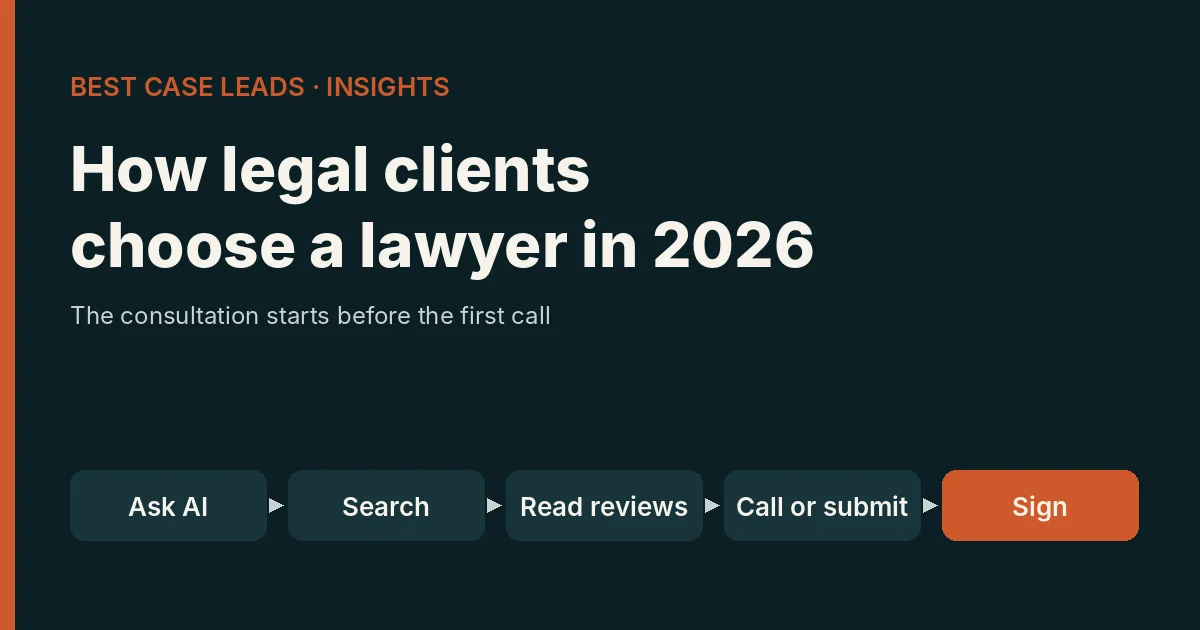
How legal consumers move from problem to signed retainer in 2026
| Stage | What the client does | Where it happens | What the firm controls |
|---|---|---|---|
| Understand the problem | Asks what their rights are, whether they have a case, what it is worth | ChatGPT and other AI tools, Google AI Overviews and AI Mode | Plain-language answers on your site that AI tools can find and cite |
| Find options | Searches "lawyer near me" or a practice area plus city | Google results, the map pack, AI answers | Google Business Profile, consistent facts across the web |
| Build a shortlist | Reads reviews, checks credentials and awards | Google reviews, review sites, bar profiles, your website | Recent reviews, honest award descriptions, clear practice-area pages |
| Make contact | Calls or submits a form, often to more than one firm | Your phone line and forms, or a lead provider | Who answers, how fast, and what they say |
| Verify | Checks you again after the first conversation | Search, reviews, AI answers | Consistency between what intake said and what the web says |
| Decide | Books the consultation and signs | Phone, video, e-signature | Clear next steps, fee terms and a fast signing process |
1. AI is now the first place clients ask
The shift happened quickly. Clio's 2026 Legal Trends Report found that nearly one in four U.S. adults (24%) has already used AI to answer a legal question, another 40% would consider doing so, and 46% would consult AI before contacting a lawyer. The 2025 edition, based on a survey of 1,000 U.S. adults weighted to census figures, found that just over half of those who used AI for a legal question said it answered the question sufficiently, and that housing, employment, contracts and constitutional rights were among the most common topics.
The same people still use Google, but Google itself now answers more of the question on the results page. In Pew Research Center's analysis of 900 U.S. adults' browsing in March 2025, 58% ran at least one search that produced an AI summary, and users clicked a traditional result in only 8% of visits with a summary compared with 15% without one. Clicks on the sources cited inside the summary were rare.
What this means for a law firm:
- Answer the questions clients actually ask. Pages that explain, in plain language, what to do after a specific kind of accident, how a workers' compensation denial is appealed, or how long a Social Security disability decision takes are the material AI tools and search engines summarize. Google's own guidance on AI features and your website says the same SEO fundamentals apply: crawlable pages, internal links, a good page experience and helpful, reliable content written for people. No special AI markup is required.
- Keep your facts identical everywhere. Firm name, address, phone, practice areas, languages and office hours should match on your website, your Google Business Profile, your bar listing and any directory. AI answers are assembled from these sources; conflicting details make a firm look less certain.
- Expect clients who have already "talked to" AI. Some will arrive better informed. Others will arrive confident about something that is wrong for their state or their facts. Train intake to ask what the person has already read, and to correct it gently, without making them feel foolish for having looked.
Clients are also wary of AI on the other side of the desk. Clio's 2025 report found that nearly half of consumers are not comfortable hiring a lawyer who uses AI to make decisions about their legal issue, and more than a third are less likely to trust a lawyer who uses AI. Use AI to move faster on intake and paperwork, and keep the advice and the judgment visibly human.
2. Reviews decide who makes the shortlist
Reviews remain the strongest trust signal a client sees before contact. BrightLocal's Local Consumer Review Survey 2026, a survey of 1,002 U.S. adults published February 11, 2026, found:
- 97% of consumers read reviews for local businesses, and 41% always do.
- 68% will only use a business rated four stars or higher; 31% want 4.5 stars or better.
- 74% want reviews from the last three months, and 32% look for reviews from the last two weeks.
- 47% won't use a business with fewer than 20 reviews.
- 89% expect business owners to respond to reviews.
- 45% have used ChatGPT or other generative AI tools for local recommendations, up from 6% the year before.
Clio's 2025 Legal Trends Report points the same way for legal services: experience and reputation are among the top factors clients consider when choosing a lawyer, with client reviews, free consultations and clear, concise information also ranking highly, now above responsiveness, which used to rank higher.
Three rules keep a review program effective and safe:
- Ask every satisfied client, every month. Recency now matters as much as the star average. A steady flow of reviews beats a one-time push.
- Never buy, fake or filter reviews. The FTC's rule on consumer reviews and testimonials, in effect since October 21, 2024, bans fake reviews (including AI-generated ones), buying positive or negative reviews, undisclosed insider reviews and review suppression, and lets the FTC seek civil penalties against knowing violators.
- Respond without revealing anything. Thank positive reviewers in general terms. For negative reviews, ABA Formal Opinion 496 (January 13, 2021) warns that a lawyer may not disclose information relating to a client's representation in reply to online criticism, and suggests that often the best response is a brief, professional one or none at all. Check your state's version of Rule 1.6.
3. Awards only help if clients can tell what they mean
Badges and "best lawyer" logos are everywhere, and clients have learned to discount the ones they cannot understand. An award with no source, year or basis can read as decoration at best and as a red flag at worst. It can also create an ethics problem: ABA Model Rule 7.1 bars false or misleading communications about a lawyer's services, and its comments warn that an unsubstantiated comparison with other lawyers may be misleading. Some states go further and require the rating organization to be named and its methodology to be available.
The fix is simple. Describe every honor in one line: who gave it, when, and on what basis. For example: "Named to [list] by [publisher], [year], based on [peer review, case results or client surveys]." Link to the source where you can. A client who understands an award trusts it; one who has to guess usually doesn't.
4. Speed still wins the call
Research does not replace the conversation; it raises the bar for it. By the time a client calls or submits a form, they have often narrowed the field to two or three firms, and the first one to respond well usually gets the consultation.
The evidence on speed is consistent:
- In a Harvard Business Review audit of 2,241 U.S. companies, only 37% responded to an online inquiry within an hour, and firms that tried to contact a lead within an hour were nearly seven times as likely to qualify it as those that waited even an hour longer, and more than 60 times as likely as firms that waited a day or more.
- In Clio's secret-shopper study of 500 law firms, only 40% picked up the phone and 48% could not be reached at all, even after messages.
- Invoca's 2025 benchmark, based on more than 60 million calls, found 37% of phone leads convert during the call itself and only 61% of callers to businesses reach a person.
For a firm buying leads, the practical standard is a first call within five minutes of delivery during business hours, an automatic text if the call goes unanswered, and a plan for nights and weekends. Live calls remove the gap entirely, because the person is already on the line. See our guides to intake speed to lead and the best time to make a follow-up call.
5. Show up consistently, not just in one place
There is no longer a single path from search to signed case. One client starts in ChatGPT, another on Google Maps, another on a review site, and almost all of them check more than one source before calling. Think of your presence as a web of places a client might land, each of which should send the same message:
- Your website: clear practice-area pages, attorney bios with bar admissions, fee basics, and plain answers to common questions. Our guide to building a lead-generating law firm website covers the structure.
- Google Business Profile: correct categories, hours, photos, service areas, and steady new reviews with replies.
- Bar and court listings: current contact details, since clients and AI tools both use them to confirm a lawyer is real and licensed.
- Review and directory sites: claimed profiles with the same name, address and phone as everywhere else.
- AI answers: test them. Ask ChatGPT, Gemini and Google's AI Mode "who is a good [practice area] lawyer in [city]" and "what do people say about [your firm]" once a month, and fix the sources behind any wrong answer.
6. Make the first conversation worth the research
When the client finally talks to your firm, they are comparing that call with everything they have read. The first few minutes should confirm what drew them in:
- Answer like you already know they did their homework. Acknowledge what they have read, then explain what applies to their state and facts.
- Give a clear next step on the first call. A booked consultation time, a list of documents to bring, and how fees work.
- Be the same firm they found online. If your reviews praise communication, intake should call back when promised. If your site promises a free consultation, intake should not hesitate to offer one.
- Sign fast. E-signature for the retainer and authorizations, sent during the call. Clio's 2025 solo and small firm report linked e-signatures to a 10% higher conversion rate.
- Track outcomes by source. Contact rate, consultation rate and sign rate by lead source show where the pre-call journey is working and where it is breaking. Our guide to converting legal leads into signed cases walks through each stage.
A pre-consultation checklist for your firm
| Check | Why it matters | Standard to aim for |
|---|---|---|
| Google Business Profile complete and verified | First thing many clients see | Categories, hours, photos, service areas all current |
| Review volume and recency | Shortlist filter | At least 20 reviews, several from the last three months, 4.0+ average |
| Review replies | 89% of consumers expect them | Brief, professional, no client information |
| Award descriptions | Credibility and Rule 7.1 | Source, year and basis listed for each |
| Consistent firm details | AI tools and directories cross-check | Same name, address and phone everywhere |
| Plain-language answers on your site | What AI tools and search summarize | A page for each common client question in each practice area |
| AI answer spot-check | Clients ask AI before calling | Monthly check of what major AI tools say about your firm |
| Speed to first contact | Leads cool within the hour | Under five minutes in business hours |
| After-hours plan | Many inquiries arrive at night | Live answering, instant text or next-morning first call |
| Outcome tracking | Shows where cases are lost | Contact, consult and sign rates by source, reviewed weekly |
How Best Case Leads fits
Best Case Leads delivers exclusive legal leads and live calls for personal injury, motor vehicle accidents, mass torts, workers' compensation, Social Security disability and more than 50 other practice areas. Every lead is verified by third-party partners before delivery, goes to one firm only, and arrives in real time by email, SMS or directly in your CRM or intake system, with no contracts or monthly commitments; you can cancel anytime. Each buyer gets an assigned Account Manager, Daily Lead Reviews and lead conversion reporting.
A great lead still checks you out before signing. The work in this article (current reviews, honest awards, consistent facts and a fast first call) is what turns that lead into a signed case at a lower cost per case.
- Personal injury leads
- Live call legal leads
- How it works
- Pricing and the cost per signed case calculator
- Legal lead conversion rate benchmarks
Related reading: re-evaluating the intake process at your law firm.
FAQ
How do people choose a lawyer in 2026? Most research their problem and their options before contacting anyone, using AI tools and Google, then shortlist firms by reviews, experience and reputation, and contact one or more of them. Clio found 46% of consumers would consult AI before contacting a lawyer, and BrightLocal found 97% of consumers read reviews.
Do clients use ChatGPT to research legal problems? Yes. Clio's 2026 Legal Trends Report found 24% of U.S. adults have already used AI to answer a legal question and another 40% would consider it. Many arrive at the first call having already read an AI answer, so intake should ask what they have read and correct anything that doesn't fit their state or facts.
How many reviews does a law firm need? BrightLocal's 2026 survey found 47% of consumers won't use a business with fewer than 20 reviews, 68% want a rating of four stars or higher, and 74% look for reviews from the last three months. Aim for steady new reviews every month rather than a single push.
Can a lawyer respond to a negative online review? Carefully. ABA Formal Opinion 496 says a lawyer may not reveal information relating to a client's representation in response to online criticism. A short, professional reply that discloses nothing, or no reply, is usually the safest course. Check your state's rules.
How should law firms display awards? Name the source, the year and the basis for each award, and link to it where possible. ABA Model Rule 7.1 prohibits misleading communications, and unexplained comparisons with other lawyers can be misleading.
How fast should a law firm respond to a new lead? Within five minutes during business hours. Harvard Business Review research found companies that contact a lead within an hour are nearly seven times as likely to qualify it, and Clio's secret-shopper study found only 40% of law firms picked up the phone.
About the author
Fadi Agour, J.D., is the Founder and CEO of FadiLaw Marketing LLC, the Houston-based parent company of Best Case Leads, Real Performance Marketing, Masstortsco, and Redo. His companies have made the Inc. 5000 fastest-growing private companies in America list seven years in a row.
Sources
- Clio: 2026 Legal Trends Report
- Clio: 2025 Legal Trends Report
- Clio: Client intake findings from the Legal Trends Report (secret-shopper study)
- Pew Research Center: Google users are less likely to click on links when an AI summary appears in the results (July 22, 2025)
- Google Search Central: AI features and your website
- BrightLocal: Local Consumer Review Survey 2026 (February 11, 2026)
- Federal Trade Commission: Final rule banning fake reviews and testimonials (August 14, 2024)
- American Bar Association: Formal Opinion 496, Responding to Online Criticism (January 13, 2021)
- American Bar Association: Model Rule 7.1, Communications Concerning a Lawyer's Services
- Clio: 2025 Legal Trends for Solo and Small Law Firms
- Harvard Business Review: The Short Life of Online Sales Leads (March 2011)
- Invoca: Cross-Channel and Cross-Industry Buyer Conversion Benchmark Report (June 2025)
This article is general information, not legal advice. Best Case Leads is not a law firm.
Check availability in your market.
Exclusivity is limited by geography. Tell us your practice area and state, and we'll confirm what's open.